The Growing Influence of Social Impact Consulting Firms in India
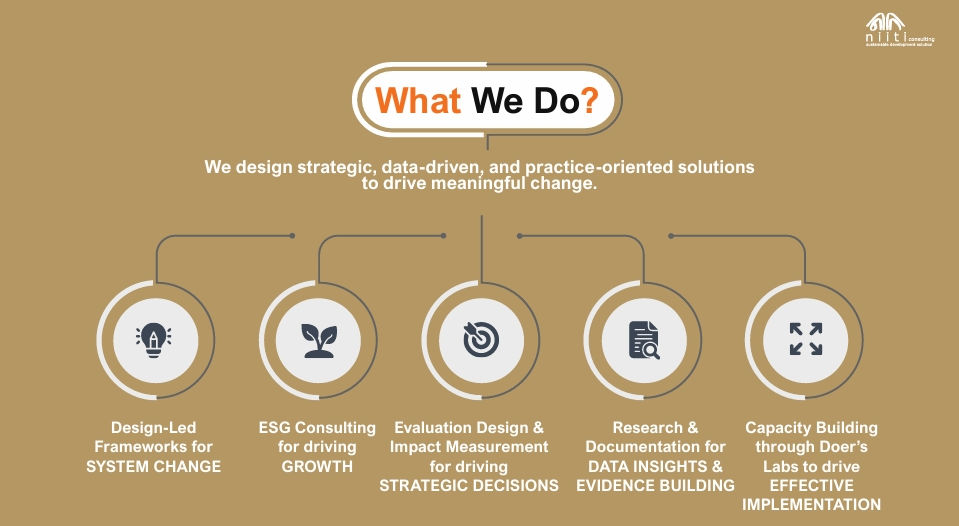
India’s development ecosystem is witnessing a dynamic shift as businesses, non-profits, and mission-driven leaders increasingly align profitability with purpose. Across diverse domains including education, healthcare, livelihood development, sustainability, and cultural preservation, there is a stronger acknowledgement that social impact and economic viability can reinforce one another. In this transforming landscape, social impact consulting firms in India play a pivotal role in shaping strategy, strengthening governance, and ensuring that initiatives deliver tangible, long-term outcomes rather than short-term optics.
Such advisory firms function at the crossroads of policy, business, and community development. Their work involves reviewing impact structures, developing scalable solutions, strengthening monitoring mechanisms, and facilitating responsible capital access. As the country continues to encourage equitable growth, the demand for formal expertise in impact assessment and sustainable innovation continues to increase.
Why Social Impact Consulting Firms in India Are Essential Today
India’s multifaceted social challenges require more than good intentions. It requires evidence-based planning, operational discipline, and contextual insight. Social impact consulting firms in India help bridge the gap between vision and execution by providing systematic frameworks that translate concepts into actionable programmes.
Such firms commonly assist organisations with baseline assessments, stakeholder analysis, programme structuring, risk assessment, and impact documentation. They help clients synchronise initiatives with compliance standards while building accountability systems that appeal to ethical investors and institutional stakeholders. In a market where accountability and measurable results face growing scrutiny, such expertise provides credibility and resilience.
Moreover, impact consulting firms assist corporate entities in structuring meaningful corporate social responsibility strategies. Instead of fragmented charity-driven models, businesses are guided towards integrated social investment frameworks that support communities while strengthening brand trust and long-term competitiveness.
The Emergence of Social Entrepreneurship in India
Parallel to consulting growth, social entrepreneurship in India has witnessed notable growth over the last decade. Social entrepreneurs combine commercial expertise with a commitment to solving critical social issues. Rather than relying solely on grants or donations, they create revenue-generating models that sustain impact over time.
India’s demographic diversity, rural-urban disparities, and digital expansion have created fertile ground for such ventures. Social enterprises are addressing challenges such as financial inclusion, accessible healthcare, waste solutions, and women’s empowerment. Their success often depends on disciplined execution, structured impact evaluation, and growth-ready business frameworks — areas where social impact consultants frequently contribute.
The shift towards purpose-led enterprise reflects a broader cultural shift. Younger founders increasingly value purpose as much as profitability. Investors, too, are evaluating ventures through environmental, social, and governance lenses. As a result, the ecosystem supporting social entrepreneurship in India is becoming progressively systematised, evidence-based, and innovation-centric.
Cultural Entrepreneurship Examples in India and Their Impact
While technology-led innovation often dominates headlines, culture-based enterprises are equally important within the social economy. There are numerous cultural entrepreneurship examples in India where heritage art forms, crafts, performances, and traditions are renewed through viable business models.
Such initiatives may involve supporting artisan groups, advancing traditional textiles, restoring folk arts, or building platforms for regional storytelling. By combining modern design approaches with ethical trade and strategic market access, cultural entrepreneurs ensure that heritage becomes an economically viable legacy instead of a disappearing practice.
For instance, enterprises that organise rural artisan collectives often focus on capacity building, quality control, and market linkage strategies. They enhance production networks while safeguarding fair wages. In doing so, they preserve cultural identity and create dignified livelihoods. Consulting expertise becomes valuable here in areas such as impact evaluation, brand positioning, and responsible expansion.
Cultural entrepreneurship also fosters community pride and tourism development. When local heritage is packaged responsibly and ethically, it creates economic opportunities without eroding authenticity. These cultural entrepreneurship examples in India demonstrate how identity and enterprise can coexist harmoniously.
Nano Enterprises and Local Economic Empowerment
At the base of the economic pyramid, nano enterprises represent a foundational but under-recognised contributor to equitable growth. Nano enterprises are extremely small, often home-based businesses typically run by individuals or families with minimal capital investment. They may operate in areas such as stitching services, food preparation, craft production, small retail, repair work, or agriculture-related trades.
Despite their scale, nano enterprises collectively contribute significantly to employment generation, especially in rural and semi-urban regions. They provide economic support in areas lacking structured employment. However, these enterprises often face systemic challenges including restricted credit access, low digital awareness, unstable supply chains, and limited social entrepreneurship in india market connectivity.
Social impact consulting firms frequently guide organisations assisting nano ventures by creating credit frameworks, capacity-building programmes, and digital integration strategies. Through structured capacity-building initiatives, nano entrepreneurs gain the tools needed to improve productivity, quality standards, and customer outreach.
The growth of nano enterprises is closely connected to women’s empowerment in India. A substantial proportion of nano entrepreneurs are women-led ventures functioning from home environments. By strengthening these enterprises, development initiatives contribute not only to income generation but also to social equity and household resilience.
Bringing Together Consulting, Entrepreneurship, and Grassroots Models
The true strength of India’s impact ecosystem lies in the alignment of formal consulting guidance, entrepreneurial initiative, and local involvement. Social impact consulting firms in India provide the structural framework that enables social entrepreneurship in India to scale responsibly. At the same time, grassroots nano enterprises and cultural ventures ensure that impact remains locally rooted and inclusive.
This integrated model ensures that innovation is not restricted to major cities. Instead, it flows into rural clusters, artisan networks, and micro-enterprise communities. Consultants help formalise systems, track results, and map growth strategies without overlooking local nuances.
Technology also serves as a key enabler within this framework. Digital payment systems, online marketplaces, and mobile-based training tools are helping nano enterprises modernise their business processes. Social enterprises leverage technology to expand reach, collect real-time data, and refine service delivery. Impact consultants evaluate these models to ensure scalability without mission drift.
Impact Measurement and Accountability in India
One of the most critical contributions of social impact consulting firms in India is building reliable impact assessment frameworks. As funding increasingly shifts towards performance-based funding and impact-aligned investment models, transparent reporting has become non-negotiable.
Impact metrics may include improvements in income levels, education outcomes, health indicators, environmental restoration, or community participation. Consultants develop logical frameworks, theory-of-change models, and monitoring tools that align activities with measurable outcomes. This structured approach minimises resource waste and strengthens stakeholder trust.
For social entrepreneurship in India, rigorous impact measurement reinforces long-term viability. Enterprises can demonstrate not only financial performance but also measurable social value creation. Cultural ventures and nano enterprises also benefit when their contributions are measured and articulated clearly.
Outlook for India’s Expanding Impact Economy
India’s socio-economic diversity ensures that the scope for social innovation remains extensive and varied. Urban innovation hubs, rural livelihood programmes, cultural enterprises, and micro-business clusters collectively create an interconnected impact environment. The collaboration between mission-driven entrepreneurs and experienced consultants will likely intensify as expectations around accountability and scalability grow.
Government policy support, private capital, and community participation are aligning to build a stronger impact ecosystem. As the ecosystem matures, social impact consulting firms in India will continue to serve as strategic enablers connecting vision with implementation while safeguarding financial and social sustainability.
The steady expansion of social entrepreneurship in India demonstrates that mission-driven enterprise has moved beyond the margins into the economic mainstream. Meanwhile, inspiring cultural entrepreneurship examples in India and the quiet resilience of nano enterprises highlight how equitable development depends on lived community experience rather than theoretical constructs.
Final Thoughts
India’s development journey is increasingly shaped by organisations and ventures that emphasise accountable and lasting impact. Social impact consulting firms provide the structure, strategy, and accountability required to transform ambitious ideas into scalable solutions. Social entrepreneurs translate purpose into practical business models solving critical problems, while cultural enterprises and nano businesses ensure that growth remains equitable and locally grounded. Together, these elements form a robust ecosystem where profit and purpose coexist, reinforcing India’s path towards balanced and responsible progress.